
8 Unconventional Nursing Careers: High-Pay, Flexibility & Fresh Opportunities
If you’ve been a nurse long enough, you’ve probably had that moment—the one where you sit in your car after a shift and think, “There has to be another way to do this.” You’re not alone. In fact, nurses across the country are having the same realization, often after long stretches of 12-hour shifts, chronic staffing shortages, and emotional exhaustion that leave them drained before they even clock in the next day.
What many nurses don’t realize—at least not right away—is that their clinical skills reach far beyond the bedside. Today’s nursing landscape is changing faster than most people expected, and nurses are stepping into roles they never knew were possible. Some are designing VR simulations. Others are building healthcare apps, teaching through podcasts, illustrating medical content, or supporting patients remotely through coaching and digital health programs. These jobs feel new, creative, and energizing—yet they still honor the heart of nursing.
Most importantly, stepping into an unconventional nursing role isn’t “leaving nursing.” Instead, it’s staying in nursing in a way that works for you. Many of these roles offer competitive pay, healthier schedules, and opportunities to rediscover the passion that brought you into the profession in the first place.
In this article, we’ll explore eight unconventional nursing jobs you may have never considered. You’ll learn what they involve, what skills they require, and how nurses are successfully transitioning into them. If you’re craving change, these paths might be exactly what you’re looking for.
The rise of nontraditional nursing jobs
Nursing is undergoing one of the most significant transformations in its history. As more nurses seek fulfilling roles outside hospital walls, the profession is expanding into spaces once considered “nontraditional.” In 2024, data showed that just over half of registered nurses—about 53%—identified hospitals as their primary workplace. Consequently, nearly half are already pursuing careers in public health, informatics, consulting, education, technology, entrepreneurship, and beyond.
This shift isn’t merely a reaction to burnout. Rather, it reflects a profession evolving alongside the broader healthcare landscape. As care moves into homes, communities, virtual environments, and digital platforms, nursing opportunities are following right behind.
Why nurses are leaving bedside roles
Turnover in bedside settings remains steep—and deeply concerning. Recent findings indicate that up to 34% of newly hired registered nurses leave their positions within the first year. Additionally, more than 138,000 nurses exited the workforce between 2022 and 2024. Looking ahead, nearly 40% of the existing workforce is projected to leave the profession by 2029 if conditions don’t improve.
So, why are so many nurses stepping away?
To begin with, the workload is simply unsustainable. Ten- to twelve-hour shifts—often repeated five or six days a week—leave little time for rest, family, or recovery. Emotional strain adds another layer: 41% of nurses cite burnout as their primary reason for leaving bedside roles.
Furthermore, many nurses feel unheard by leadership. Nearly half say that “administration does not listen or respond to clinician concerns,” pointing to an environment where nurses often feel unsupported. Safety concerns also contribute significantly; one in five nurses report leaving a job because conditions felt unsafe.
These pressures have intensified since COVID-19. Many nurses now juggle caregiving at home, school-age children, or their own health needs while working in high-stress environments. As staffing shortages deepen, workloads increase—and burnout accelerates.
Given all this, it’s no wonder so many nurses are reimagining what their careers can look like.
How technology and creativity are reshaping nursing
Technology is redefining nursing—not by replacing nurses, but by opening doors that didn’t exist before. AI-enhanced tools, automation, and predictive analytics are helping reduce documentation burdens and support clinical reasoning. In 2024 alone, more than 65% of hospitals reported adopting some form of AI for workflow optimization or patient monitoring.
As these technologies evolve, nurses are increasingly involved in designing, testing, and implementing them. Their firsthand clinical insight ensures digital tools function in the real world, not just on paper. As a result, entirely new career paths in informatics, data science, UX design, digital health, and VR simulation are emerging.
Telehealth continues to be one of the biggest drivers of change. Even after the pandemic, virtual care remains strong. Many nurses now work remotely in triage, case management, tele-ICU programs, and digital chronic-disease management—roles that offer autonomy, flexibility, and freedom from physical strain.
Additionally, creativity is reshaping the profession. Social media platforms and digital education tools allow nurses to teach, advocate, and create content for global audiences. Some nurses have turned these creative roles into full-time careers as medical illustrators, podcasters, YouTubers, and brand partners. Their clinical expertise gives their work unmatched credibility.
Ultimately, technology isn’t pulling nurses away from the profession—it’s expanding what nursing can be.
Benefits of exploring alternative nursing careers
One of the most immediate benefits of stepping beyond bedside nursing is the return of balance. Traditional nursing schedules—built around long shifts, rotating weekends, and holiday requirements—can wear down even the most dedicated clinicians. In contrast, alternative nursing careers often provide predictable hours, remote options, or flexible schedules. For nurses with families, chronic health conditions, or simply a desire to sleep normal hours, these roles can be life-changing.
Beyond balance, alternative roles promote greater independence. While bedside care relies heavily on teamwork, nontraditional positions—such as coaching, consulting, education, and informatics—allow nurses to own their workflow and structure their day.
These roles also allow nurses to lean into their natural strengths. A nurse who loves design may thrive in UX. Another who enjoys breaking down complex concepts may flourish in simulation education or content creation. Meanwhile, nurses who value deep ethical conversations may gravitate toward healthcare ethics.
Human-centered skills—communication, empathy, judgment, collaboration—remain crucial. However, in alternative roles they often shine in new ways, especially as healthcare becomes increasingly digital and interdisciplinary.
8 unconventional nursing jobs you’ve probably never heard of
The nursing world extends far beyond hospital hallways, opening opportunities that blend clinical expertise with technology, creativity, and innovation. These roles often offer competitive salaries—typically $65,000 to $130,000 depending on experience and location—and a healthier work–life balance.
Below are eight unique jobs redefining what it means to be a nurse today.
1. VR Simulation Nurse Designer
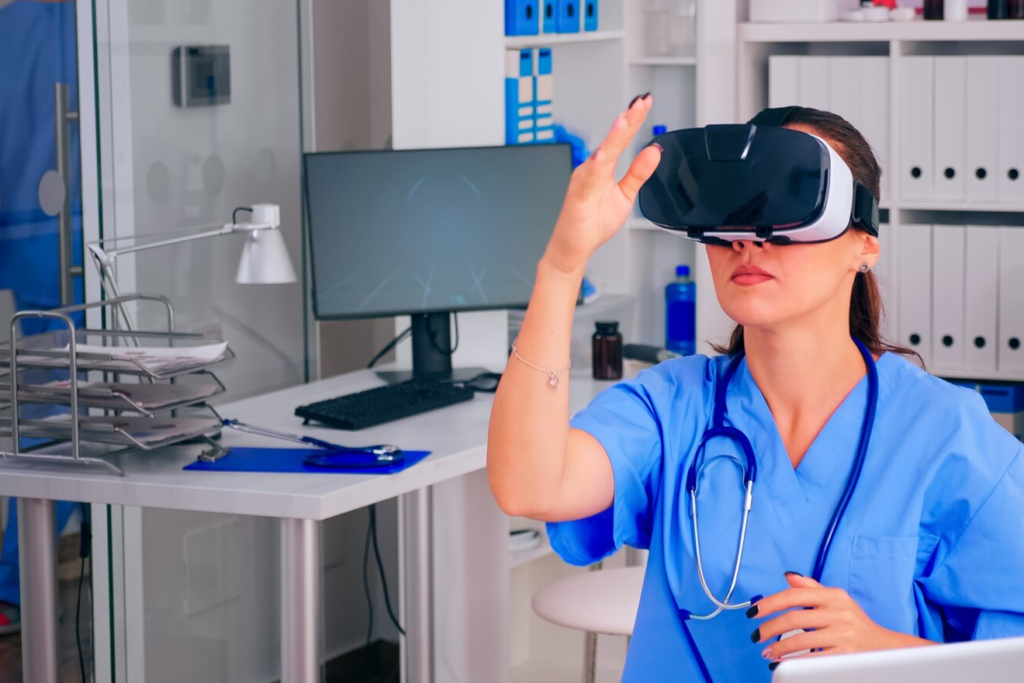
As virtual reality becomes a cornerstone of healthcare education, nurses are stepping into roles that blend clinical accuracy with immersive technology. VR simulation nurse designers help build lifelike training experiences that let students and new clinicians practice critical skills in a safe, controlled environment. Their nursing background gives them unique insight into real-world workflows, patient scenarios, and clinical decision-making—something traditional game developers can’t replicate.
Most VR simulation designers earn $70,000–$100,000, depending on their software skills and the organization. Nurses who master tools like Unity, Unreal Engine, or simulation authoring platforms (such as SimX or Oxford Medical Simulation) are especially competitive. These roles often appear in nursing schools, hospital education departments, and healthcare-focused ed-tech startups.
2. Medical Illustrator or Animator
Nurses with artistic talent can transform complex medical concepts into visuals that educate patients, explain procedures, and support surgical training. Medical illustrators and animators create everything from anatomical diagrams to 3D surgical animations. While many medical illustrators have specialized art degrees, nurses bring a clinical depth that’s hard to teach—giving them a major advantage in accuracy and detail.
Full-time medical illustrators typically earn $65,000–$85,000, while highly specialized freelancers or 3D medical animators can surpass $100,000. Nurses interested in this path often build portfolios that combine clinical insight with visual storytelling and may take courses in scientific illustration or digital animation.
3. Nurse Game Developer
Educational gaming is emerging as a powerful tool in medical training—and nurses are increasingly helping design these clinical learning experiences. Nurse game developers work with software engineers, instructional designers, and artists to build games that teach clinical reasoning, communication, and procedural skills.
Depending on the company and tech skill set, salaries usually range from $65,000–$110,000. Nurses with strong clinical backgrounds who can contribute to gameplay accuracy, scenario writing, or simulation logic are especially valuable. Experience with game engines, scenario scripting, or instructional design makes the transition easier.
4. Clinical UX/UI Consultant
Healthcare technology desperately needs clinicians who can improve usability and workflow. Nurses who move into UX/UI consulting help shape the way electronic records, clinical apps, and digital tools look, feel, and function. They translate clinical needs for developers and ensure that technology supports—not disrupts—patient care.
Clinical UX/UI consultants typically earn $80,000–$120,000, with higher pay in tech-heavy markets or for senior consultants. Nurses in these roles often learn user-research methods, prototyping, and usability testing. Their clinical credibility makes them invaluable partners in designing safer, more intuitive digital tools.
5. Nurse Podcaster or Content Creator
Nurses have become influential voices online, using podcasts, YouTube, TikTok, and blogs to educate, advocate, and entertain. These roles allow nurses to share knowledge creatively while building personal brands and multiple income streams.
Earnings vary widely—from $30,000 in supplemental income to $100,000+ for nurses who secure sponsorships, ad revenue, merch sales, or speaking engagements. Success depends more on consistency and audience engagement than credentials. Nurses who love storytelling and want more autonomy often thrive in this space.
6. Simulation Lab Coordinator
Simulation lab coordinators oversee hands-on learning environments where healthcare professionals practice clinical skills using high-fidelity manikins, mock hospital rooms, and simulated scenarios. Nurses excel in these positions because they understand real clinical workflows and can craft scenarios that feel authentic and emotionally real.
Salaries typically range from $80,000–$120,000, depending on the size of the institution and the coordinator’s level of responsibility. These roles often involve a mix of teaching, equipment management, scenario design, teamwork, and debriefing skills.
7. Nurse Health Coach
Nurse health coaches guide clients through lifestyle changes, chronic disease management, and personalized wellness plans. They often focus on niches such as weight loss, integrative health, stress reduction, or corporate wellness. Many work remotely or run their own businesses, offering flexible schedules that support work-life balance.
Salaried nurse health coaches typically earn $60,000–$90,000, while private-practice coaches—especially those serving executive or concierge clients—can make $100,000+. Many pursue additional certifications in coaching, integrative health, or functional medicine.
8. Nurse Ethicist
As healthcare grows more complex, hospitals and universities increasingly rely on nurse ethicists to help navigate difficult decisions about end-of-life care, informed consent, resource allocation, and emerging technology. These nurses sit on ethics committees, develop policy, educate teams, and provide guidance during ethically challenging cases.
Nurse ethicists usually earn $80,000–$130,000, with higher compensation in academic medical centers or leadership positions. Most complete additional training in bioethics, philosophy, or healthcare policy. This path appeals to nurses who excel in communication, critical thinking, and advocating for patients in gray areas of care.
What skills do these unique RN jobs require?
Stepping into unconventional nursing roles doesn’t require abandoning your foundation. In fact, your bedside experience is often what makes you uniquely qualified. These roles simply combine your clinical strengths with new tools, new perspectives, and new ways of supporting patients and healthcare systems.
Creative thinking and design knowledge
Creativity is a natural part of nursing, even if it isn’t always recognized. Nurses think on their feet, anticipate problems, adapt rapidly, and visualize next steps during patient care. In unconventional roles, this creativity becomes a central asset.
Whether designing VR scenarios, sketching medical illustrations, or developing intuitive digital workflows, nurses use creative thinking to solve problems in new settings. Healthcare leaders increasingly acknowledge creativity as a core nursing skill—one that drives innovation across the entire system.
Tech literacy and software familiarity
Digital fluency is no longer optional. Nurses pursuing roles in simulation, informatics, UX, or digital education need to feel comfortable navigating software, analyzing data, and understanding workflows.
Nurses in tech-forward roles typically spend 8–9 hours per day interacting with digital tools. Fortunately, these skills are highly teachable. Many nurses gain them through short courses, certificates, or hands-on practice long before landing their first role in tech.
Strong communication and storytelling
Clear communication is one of the strongest predictors of success in unconventional nursing careers. Nurses in these roles must translate complex medical concepts into accessible language—whether through podcasting, teaching, content creation, or design.
Storytelling is increasingly recognized as a powerful healthcare skill. From writing scripts to crafting patient education materials, nurses use narrative thinking to build trust and spark engagement.
Understanding of healthcare systems
Unconventional nursing jobs require an ability to see the “big picture.” Nurses who thrive in these roles understand clinical workflows and how multiple parts of the system connect.
This systems-level thinking allows nurses to bridge clinical and non-clinical worlds. Whether working in ethics, informatics, UX, or simulation, they help teams design solutions that truly support patient care—not just theoretical improvements.
How to transition into out-of-the-box nursing jobs
Career transitions take time, but they don’t require starting over. With a strategic approach and targeted learning, nurses can break into new fields more easily than they might think.
Start with certifications or short courses
Targeted training is one of the most effective ways to break into a new niche. For simulation and VR roles, CHSE or CHSOS credentials are highly respected. Nurses interested in illustration or animation often explore programs through the Association of Medical Illustrators or scientific illustration courses. UX-focused nurses benefit from certificates in UX design or usability testing, while health coaches pursue NBC-HWC or integrative health credentials. Nurse ethicists typically complete graduate-level bioethics training.
These programs send a clear message: you’re serious about your next step.
Build a portfolio or side project
A simple portfolio can make you stand out immediately. It showcases your skills through real examples—VR scenarios, illustrations, UX mock-ups, writing samples, or workflow diagrams. Even a few high-quality projects can open doors and help employers understand what you can bring to the table.
Network with professionals in niche fields
Many unconventional nursing opportunities never appear on job boards. Reaching out to professionals in your target field—through LinkedIn, conferences, online communities, or professional groups—can provide insider insight and put you on the radar when new roles emerge.
Make use of your clinical experience
Your nursing background is not something you leave behind—it’s your superpower. Critical thinking, crisis management, collaboration, and patient education are invaluable in tech, education, ethics, coaching, and design. You’re not starting over; you’re evolving.
Conclusion
If you feel a pull toward something different—even if you’re unsure what that “something” is—trust that instinct. Nursing has always been a profession rooted in adaptability and innovation. Today’s healthcare environment offers more pathways than ever before, and the nurses who thrive are the ones willing to explore them.
You can design VR simulations, illustrate complex anatomy, create educational content, support patients through wellness coaching, shape hospital ethics policies, or contribute to the development of safer healthcare technology. These roles don’t pull you away from nursing—they expand what nursing can be.
Your next step doesn’t have to be dramatic. Start small. Explore a certificate course. Build a sample project. Reach out to someone who is already working in a role you admire. Every nurse who made the transition started the same way—with curiosity, not certainty.
Your bedside experience gave you the foundation. Now, you get to decide where that foundation leads. Nursing’s future is wide open, and there is absolutely a place in it for you—whether your passion lies in creativity, technology, problem-solving, teaching, storytelling, or innovation.
The bedside may have been your beginning, but it doesn’t have to be your end. The nursing world is bigger than you think—and it’s ready for you.
References
[1] – https://absn.csp.edu/why-become-a-nurse/alternative-nursing-careers/[2] – https://medicalhero.com/digital-skills-for-nurses-a-comprehensive-guide/
[3] – https://pmc.ncbi.nlm.nih.gov/articles/PMC3990376/
[4] – https://www.purdueglobal.edu/blog/nursing/communication-in-nursing/
[5] – https://www.arizonacollege.edu/blog/how-a-nursing-portfolio-can-elevate-your-career/
[6] – https://pmc.ncbi.nlm.nih.gov/articles/PMC9543513/
[7] – https://www.joyce.edu/blog/alternative-nursing-jobs/
[8] – https://acceleratednursing.utica.edu/blog/10-alternative-careers-for-nurses/
[9] – https://collaboratingdocs.com/the-most-common-career-changes-for-nurses-where-to-go-next/
[10] – https://pmc.ncbi.nlm.nih.gov/articles/PMC8939908/
[11] – https://bmcnurs.biomedcentral.com/articles/10.1186/s12912-024-02277-1
[12] – https://pmc.ncbi.nlm.nih.gov/articles/PMC11520911/
[13] – https://www.cannondesign.com/perspectives/engaging-nurses-building-design-enhances-outcomes
[14] – https://bmcnurs.biomedcentral.com/articles/10.1186/s12912-025-03927-8
[15] – https://nursejournal.org/careers/non-bedside-jobs-for-nurses/
[16] – https://nightingale.edu/blog/alternative-nursing-careers.html
[17] – https://nursejournal.org/resources/networking-in-nursing/
[18] – https://absn.ndm.edu/blog/networking-in-nursing/
[19] – https://medium.com/grow-yourself-grow-your-business/transitioning-from-bedside-nursing-the-secrets-no-one-tells-you-1663c6b22488
[20] – https://generalassemb.ly/blog/making-a-career-transition-from-nursing/
[21] – https://nurse.org/education/career-change-nurse/
[22] – https://www.chicagotribune.com/2020/03/22/this-artist-got-his-start-as-an-icu-nurse-2/
[23] – https://www.nytimes.com/interactive/2022/10/07/t-magazine/art/nate-lewis-art.html
[24] – https://www.youtube.com/watch?v=5W7aturngYk